Wire dispatch
Everything you need to know about mute swans
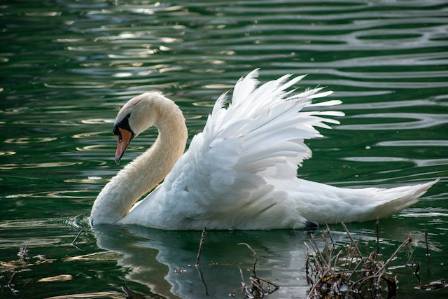
Mute swans are a familiar sight on ponds, lakes, rivers, and other waterways in urban areas. Because they often live close to towns and cities, many people encounter them during everyday walks and exercise near their homes. They are the largest and heaviest waterfowl species in the British Isles and are also the only swan species there that remains year-round rather than migrating. However, they may still travel to different parts of the country during winter when better feeding opportunities are available.
Tessa Marlow
Wire note
Signal tip
The full dispatch write-up continues below on the discovery terminal.
Channel
Discovery Wire
Mute swans are a familiar sight on ponds, lakes, rivers, and other waterways in urban areas. Because they often live close to towns and cities, many people encounter them during everyday walks and exercise near their homes. They are the largest and heaviest waterfowl species in the British Isles and are also the only swan species there that remains year-round rather than migrating. However, they may still travel to different parts of the country during winter when better feeding opportunities are available.
What Does a Mute Swan Look Like?
Adult mute swans have entirely white plumage, although their heads can sometimes become stained a rusty brown color when they spend time feeding in acidic water.
The male is called a cob, while the female is known as a pen. The two sexes look very similar, but the male is generally larger, with a somewhat longer head and body and a broader wingspan. During the breeding season, the black knob at the base of the male's bill becomes swollen and much more prominent than that of the female. Outside the breeding period, however, telling males and females apart can be quite difficult.
Young mute swans have bills without the prominent frontal knob found in adults. Their bills are initially pinkish-grey with black areas, gradually becoming more pink during their first winter. By their second winter, they develop the shape and coloration characteristic of adults.
Cygnets can look quite different from adults when they hatch. Their bodies may be covered in dusky brownish-grey down, while their bills are grey-black.
What Sounds Do Mute Swans Make?
Despite their name, mute swans are not actually silent. They are simply the least vocal of the swan species. They produce a range of short grunts and hissing sounds.
During the breeding season, they can also make brief, powerful snorting noises. Unlike some other swan species, however, they do not produce the familiar honking calls associated with birds in flight. When a mute swan is flying, the most noticeable sound may simply be the rhythmic beating of its wings.
Feeding and Habitat
Mute swans mainly feed by stretching their long necks beneath the surface of the water. They frequently tip their bodies forward to reach submerged vegetation, although they also dabble in shallow water and graze on land.
They favor freshwater habitats in lowland areas, including lakes, ponds, reservoirs, gravel pits, rivers, canals, and park lakes. They can also be found in estuaries, coastal brackish lagoons, and sheltered bays along the coast.
Pair Bonding
Mute swans can begin forming pair bonds when they are around two years old. They are not normally fully mature until approximately three years of age, although they may breed at that point if a suitable territory is available.
The amount of food available in an area plays an important role in determining territory size. Where common duckweed and similar food sources are abundant, breeding pairs may be able to establish territories relatively close to one another.
A mated pair will generally remain together in the same area throughout their lives and often return to the same nesting site. As long as both birds remain healthy, they will usually continue as a pair.
Conflicts over territory can become extremely aggressive and, in some cases, may result in the death of one of the birds. Although swans do not necessarily die from grief after losing a mate, they commonly experience a period of mourning. There are also documented situations in which a swan takes a new partner, particularly when a stronger cob takes control of an existing territory.
Breeding
During the breeding season, mute swans become highly territorial and will drive most other wildfowl away from the area surrounding their nest. For this reason, people should give breeding swans plenty of space when walking near waterways, especially when accompanied by a dog.
The nest is a large mound constructed from vegetation and is usually positioned close to the water's edge, often among tall plants growing along the shoreline.
Breeding generally takes place during spring. The female lays approximately one egg every other day, producing a clutch of around 5 to 12 eggs. During incubation, the female develops a completely featherless section of skin on her underside known as a brood patch.
The female removes feathers from this area and uses them to help line the nest. The exposed skin allows the eggs to remain closer to her body and receive warmth during incubation. She incubates the eggs for approximately 35–42 days and regularly turns them with her bill.
While the female leaves the nest to feed and preen, the male helps keep the eggs warm and guards the nesting area. Male mute swans do not have a brood patch and are rarely able to incubate the eggs themselves, except when the cygnets are very close to hatching.
Most of the eggs in a clutch hatch within approximately 24 hours of one another. After hatching, the cygnets remain on the nest for another day before making their way into the water. The parents help feed them by pulling up aquatic weeds and disturbing sediment from the bottom of the river or other waterway.
Protecting the Cygnets
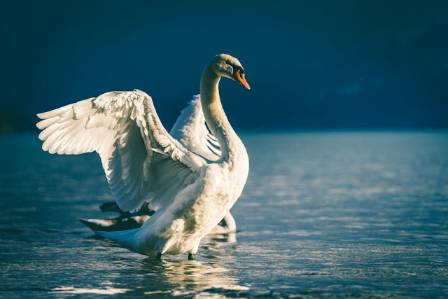
When the cygnets are still small, they are frequently carried on their mother's back. The male can become especially defensive when an intruder approaches. He may swim toward the perceived threat with abrupt, jerking movements, holding the inner wing feathers in an arched position while drawing his neck backward over his shoulders.
Growth and Molting
Newly hatched cygnets are grey with black bills. Over their first six months, their plumage gradually develops a brownish coloration, and they learn to fly during this period.
By approximately one year of age, young swans are mostly white, although their bills remain greyish or pink. The completely white adult plumage and orange bill develop once the bird reaches maturity.
The timing of the annual molt differs according to age and breeding status. Immature and non-breeding swans molt first. Breeding females molt afterward, and the male begins his molt only once the female has completely finished and regained the ability to fly.
This sequence ensures that at least one parent remains capable of flight and can defend the cygnets if necessary.
When resting, mute swans will often pull one foot upward and tuck it against their back. This behavior may simply help the foot dry, although it can sometimes make observers think the bird has suffered an injury.
More on the wire
LOG · en

The Space Needle: Seattle’s Most Famous Landmark
The Space Needle is widely recognized as one of the most iconic symbols of Seattle and one of the most memorable structures in the United States. Constructed for the 1962 World’s Fair, this futuristic observation tower quickly became the centerpiece of Seattle’s skyline.
LOG · en

The best portable bluetooth speakers for every adventure
Portable Bluetooth speakers make it easy to bring your favorite music wherever life takes you. Whether you're relaxing by the pool, spending a day at the beach, camping under the stars, hiking through nature, or getting ready for a night out, a quality speaker can instantly enhance the experience.
LOG · en

Best Sedans of 2026
Top-rated sedans combine comfort, interior space, and an engaging driving experience. While they don’t offer the cargo capacity of SUVs, they compensate with better handling and improved fuel efficiency.
LOG · en

Rocket to the Stars
Humanity has always looked to the stars with wonder and curiosity. In recent years, advances in rocket technology have transformed these dreams into achievable goals. Rockets are no longer just vehicles for scientific exploration; they are gateways to new worlds and endless possibilities. As the space industry evolves, we see exciting opportunities unfolding that could change our understanding of the universe and our place within it.
LOG · en

Golden Bridge, Vietnam: Complete Travel Guide
The Golden Bridge (Cầu Vàng), also known as the Hands of God Bridge, has become one of Vietnam’s most iconic landmarks. Nestled high in the mountains above Da Nang, this pedestrian bridge appears to float in the sky, held up by two giant stone hands. It’s both a stunning feat of architecture and a must-visit destination for travelers seeking unforgettable views and photos.
LOG · en

A Guide to America’s Best Beaches
Each year, millions of people head to the shoreline in search of sunshine, relaxation, excitement, and seaside fun. Picture yourself resting on soft, clean sand while warm sunlight touches your skin and a refreshing ocean breeze moves through the air. The best part is that many of the world’s most stunning beaches can be enjoyed without ever needing a passport.