Wire dispatch
Radio Telescopes: Exploring the Invisible Universe
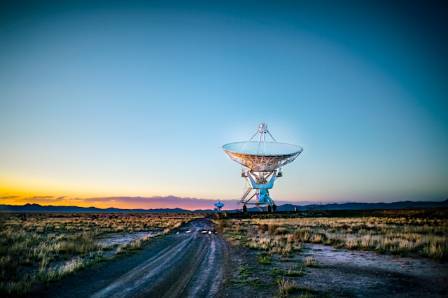
Just as optical telescopes gather visible light, focus it, amplify it, and make it available for study through various instruments, radio telescopes perform a similar role with radio waves. They collect faint radio emissions from stars, galaxies, black holes, and other celestial bodies, amplify these signals, and transmit them for analysis. Radio telescopes can also send radio waves to planets and moons within our solar system and measure the reflected signals.
Finley Ross
Wire note
Signal tip
The full dispatch write-up continues below on the discovery terminal.
Channel
Discovery Wire
Just as optical telescopes gather visible light, focus it, amplify it, and make it available for study through various instruments, radio telescopes perform a similar role with radio waves. They collect faint radio emissions from stars, galaxies, black holes, and other celestial bodies, amplify these signals, and transmit them for analysis. Radio telescopes can also send radio waves to planets and moons within our solar system and measure the reflected signals.
These specialized instruments observe the longest wavelengths of light, ranging from 1 millimeter to more than 10 meters. By comparison, visible light waves are only a few hundred nanometers long—tiny fractions of a millimeter! In practice, radio waves are typically described by their frequency rather than their wavelength.
Cosmic radio signals are incredibly faint when they reach Earth. A typical cell phone emits signals a billion billion times stronger than the radio waves astronomers detect from space.
Structure of a Radio Telescope
Radio telescopes come in diverse shapes and sizes, depending on the wavelengths they are designed to detect. Every radio telescope, however, includes an antenna mounted on a support structure and at least one receiver to capture signals.
Because radio waves have long wavelengths and astronomical sources emit extremely weak signals, radio telescopes are among the largest scientific instruments on Earth, and their receivers must be highly sensitive. These massive antennas are also susceptible to interference from human-made electronics, so great care is taken to minimize radio frequency contamination.
The Antenna
A basic example of a radio antenna is a metal dipole, similar to those on vehicles for receiving broadcast radio.
The most advanced and versatile radio telescopes use parabolic dish antennas. The parabolic shape directs incoming waves to a single focal point above the dish. Parabolic dishes can capture multiple wavelengths simultaneously, but different receivers are needed for specific frequency bands. To target a particular wavelength, engineers use specialized funnel-shaped structures called feed horns, with the largest sometimes as big as a pickup truck.
The narrow end of a feed horn matches the wavelength it is designed to detect. As the radio wave travels down the horn, it resonates perfectly with the walls, and the horn acts as the true detector. At this point, a supercooled receiver collects the signal and sends it to computers for analysis.
Feed Supports
Feed horns and receivers can be mounted directly above the dish at the focal point, or a mirror can redirect the focused waves to the center of the dish where multiple receivers are located.
When receivers are positioned at the focus above the dish, signals travel through cables along the feed structure to a ground-level facility for recording. These prime focus feeds are limited by the weight and size that can safely be suspended above the dish and by how accessible they are for maintenance.
More commonly, a secondary mirror called a subreflector redirects the focused waves from the prime focus to a central location. Subreflectors can be adjusted to target different feed horns or capture a broader view of the sky, sometimes to collect atmospheric or environmental data.
Dish Surface
For very short radio waves, such as millimeter wavelengths observed by ALMA, the dish’s surface must be extremely precise. Any distortion, dent, or warp can scatter these tiny waves, causing data loss.
Dishes must also endure environmental challenges like wind, temperature changes, and gravitational effects as they move. ALMA’s dishes are kept relatively small to maintain their precision under such conditions.
For longer wavelengths, such as centimeter waves observed by the VLA and VLBA, perfect surface accuracy is less critical. These dishes are built sturdy and can withstand harsh conditions while still performing well.
Telescope Mounts
Some dishes rotate on equatorial mounts aligned with the North Star. These mounts allow the telescope to track celestial objects as the Earth rotates. However, equatorially mounted telescopes are difficult to construct because the massive dish must remain balanced at awkward angles. The 140-foot Green Bank Telescope is the largest such telescope ever built.
Most modern radio telescopes are steered digitally using simpler tilt-and-turn axes. This allows even very heavy telescopes, like the 17-million-pound Green Bank Telescope, to track objects across the sky accurately.
Data Processing
Early radio telescopes tuned to a single frequency to detect signals from molecules in space. Today, computers split wide frequency bands into thousands of channels, similar to moving from black-and-white to full-color imaging.
To detect faint signals, telescopes observe the same source for hours, analogous to leaving a camera shutter open. Software sums the collected waves repeatedly to enhance astronomical signals and averages out random noise from receivers and the atmosphere.
Why Arrays Are Used
The ability to see fine detail, known as angular resolution, depends on the wavelength observed divided by the antenna size. Since radio wavelengths are long, even the largest single antennas achieve resolutions comparable to the unaided eye. To match optical telescope detail, antennas must be extremely large.
The Green Bank Telescope, 100 meters in diameter, is the largest fully steerable dish. The massive 1000-foot Arecibo dish could not move, but it directed its receivers to target the sky. It was built in a natural sinkhole to support the enormous structure.
The solution to increasing resolution: combine multiple antennas across a wide area to act as a single, giant telescope. This technique won a Nobel Prize.
When two antennas observe the same source, the signal reaches each at slightly different times, creating phase differences. By measuring these delays, astronomers reconstruct high-resolution images.
The Atacama Large Millimeter/submillimeter Array
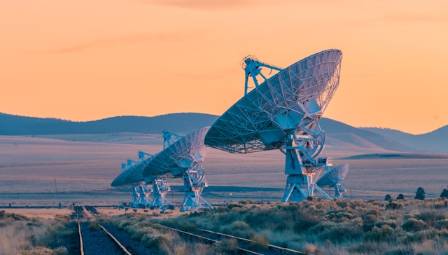
ALMA links 66 dishes with a supercomputer to process signals collaboratively. As Earth rotates, distances from the source to each dish change, producing different phase delays. These variations provide multiple perspectives of the same object, improving resolution.
Arrays like ALMA and the VLA use a central local oscillator to send timing signals to each antenna, synchronizing data collection. The correlator computer combines these signals, performing calculations at femtosecond speeds to create maps of celestial radio sources.
Very Long Baseline Interferometry (VLBI)
The farther apart antennas are, the finer the detail they resolve. VLBI allows widely separated radio telescopes to function as one massive instrument, precisely locating radio sources in space. The VLBA is the world’s largest dedicated VLBI network.
Because fiber optics are impractical over long distances, each telescope uses an atomic clock to timestamp data. Hydrogen maser clocks provide timing accurate to billionths of a second. Hard drives with this time-stamped data are physically transported to a central correlator, where the information is digitally combined to create high-resolution observations, typically delivered to scientists within weeks.
This combination of large dishes, arrays, precision timing, and supercomputing allows radio astronomers to study the universe in unprecedented detail, unlocking the secrets of galaxies, stars, and other distant phenomena.
More on the wire
LOG · en

Explore Iconic Mountain Ranges with Unforgettable Walking Adventures
Whether you're drawn to the jagged snow-covered summits of the Himalayas or the gentle meadows of the Pyrenees, our mountain walking holidays offer thrilling treks across some of the world’s most majestic ranges. Below is a guide to just a few of the awe-inspiring landscapes waiting to be explored.
LOG · en

The Definitive Guide to Selecting the Ideal Women’s T-Shirt
A high-quality t-shirt is the fundamental building block of any wardrobe. When chosen correctly, it offers a blend of comfort, aesthetic appeal, and longevity that withstands daily wear. Finding a garment you will reach for consistently involves looking beyond the surface to evaluate the textile, the silhouette, and the integrity of the manufacturing. This guide breaks down the essential factors to consider when investing in this timeless staple.
LOG · en

5 Japanese Spices: Professional Techniques for Authentic Home Cooking
Authentic Japanese cuisine is defined by its delicate balance of flavors, and that balance hinges on five essential spices: shichimi togarashi, wasabi, sansho pepper, gomashio, and katsuobushi. Unlike generic seasoning blends that offer one-note flavor, these ingredients form the foundation of Japan’s culinary identity—from sansho pepper’s citrusy numbing kick to katsuobushi’s deep, savory umami. This guide goes beyond basic ingredient lists to unpack professional techniques for using each spice, common pitfalls to avoid, and trusted sources for authentic versions (not the watered-down imitations often found in supermarkets). Whether you’re a home cook looking to elevate ramen, sushi, or rice dishes, mastering these spices will transform your cooking from simply “Japanese-inspired” to genuinely true to tradition.
LOG · en

An Introduction to the Hoopoe: Nature's Crowned Aviator
The Hoopoe (Upupa epops) is a remarkably vibrant bird found throughout Afro-Eurasia. It is most famous for its distinctive "crown" of feathers, an ornate crest that it can raise or lower at will.
LOG · en

The Essence of Men’s Artistic Gymnastics: A Comprehensive Guide to the Six Disciplines
Men’s artistic gymnastics (MAG) stands as the cornerstone of gymnastics, with roots tracing back to ancient Greece, where athletes trained in strength, flexibility, and precision to prepare for warfare and competition. Recognized as the oldest form of organized gymnastics, it evolved through centuries—from 19th-century European gymnasiums to its debut as an Olympic sport at the first modern Games in 1896—to become a showcase of human physical excellence. At the elite level, MAG athletes compete across six demanding disciplines: floor exercise, pommel horse, still rings, vault, parallel bars, and high bar. Each event demands a unique blend of core skills—strength, balance, coordination, agility, and mental fortitude—while pushing the boundaries of what the human body can achieve. Below is an in-depth exploration of each discipline, uncovering the technical nuances, historical context, and competitive standards that define men’s artistic gymnastics.
LOG · en

Eleven Works of Plein Air Painting Inspired by Rivers and Woods
The practice of plein air painting—creating art directly from life outdoors—offers a unique and immediate connection to nature. Rivers and wooded landscapes, with their dynamic light, complex textures, and serene beauty, provide endless inspiration for artists. The following collection highlights eleven notable plein air or plein air-inspired works that capture the essence of these natural subjects.