Wire dispatch
Make Restaurant-Quality Scallion Oil Noodles at Home
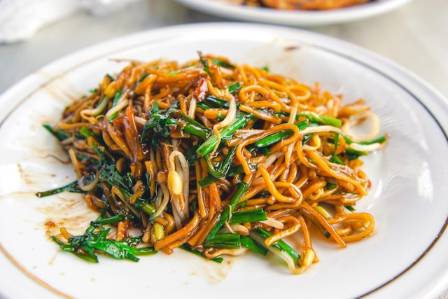
Scallion oil noodles are a beloved staple in Shanghai cuisine, enjoyed in a variety of settings: devoured at bustling street stalls, savored in upscale restaurants, or whipped up quickly at home.
Adelaide Rose
Wire note
Signal tip
The full dispatch write-up continues below on the discovery terminal.
Channel
Discovery Wire
Scallion oil noodles are a beloved staple in Shanghai cuisine, enjoyed in a variety of settings: devoured at bustling street stalls, savored in upscale restaurants, or whipped up quickly at home.
The dish’s widespread popularity, which continues to grow in the United States, is easy to understand. Chewy noodles coated in fragrant scallion-infused oil, rich soy sauce, and a touch of sugar create a flavor profile that is far more satisfying than the sum of its individual components.
To get insight into this global phenomenon, I spoke with my colleague Valerie Sizhe Li, who grew up in Shanghai enjoying countless bowls of this noodle dish. She explained, “I ate this so frequently as a kid that I hardly noticed it—only when I moved away did I realize how much I missed it. As someone who usually eats a lot of meat, this is one of my favorite meat-free dishes. It’s slightly sweet, intensely savory, and the noodles are tender yet springy. Every bite is incredibly satisfying.”
As the name suggests, scallion oil noodles rely on an infused oil to bring the dish together. The greens of the scallions are first fried until crisp, set aside, and later used as a garnish, while the white parts are slowly simmered in peanut oil with shallots and ginger to build depth of flavor.
If desired, the scallion oil can be prepared in large quantities and refrigerated for future use. According to Li, this versatile oil pairs beautifully with other dishes, from additional noodles to steamed chicken or even fried eggs.
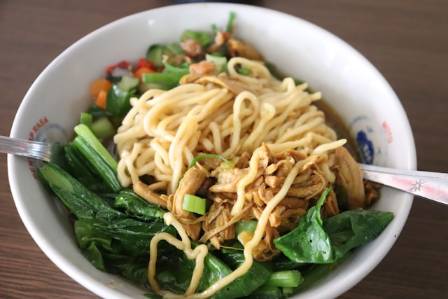
“This is a dish anyone can make at home,” Li said. “It’s my reliable go-to, like comfort food. For me, it’s the noodle equivalent of mac and cheese.”
Once the scallion whites are tender and the oil fragrant, dark soy sauce is added to give the noodles their signature glossy, deep color and umami richness. Light soy sauce can then be incorporated to enhance the overall savory flavor. Achieving a thick, shiny sauce is highly valued in Shanghainese cooking; chefs often aim for what is called “nong you chi jiang,” meaning “rich in oil and red in sauce.”
Shanghainese cuisine also tends to feature a subtle sweetness. Here, sugar is added to the soy mixture to create a balanced sweet-and-savory taste. Freshly cooked noodles, with their ideal chewiness, are tossed in the sauce until fully coated. The dish can be served plain or accompanied by a variety of toppings. In busy Shanghai restaurants, diners often personalize their bowls with toppings like braised pork chops, stir-fried ground pork, blanched bok choy, mustard greens, or crispy fried eggs.
In homage to the classic version, and one of Li’s favorites, we top our noodles with crispy scallion greens. These are shallow-fried in the wok before assembling the dish, turning dark brown and perfectly crunchy.
The final result is a harmony of textures and a luscious, savory sauce that keeps you coming back for more, making scallion oil noodles an irresistible comfort food with endless appeal.
More on the wire
LOG · en

Iconic classic cars of all time
Nothing evokes passion and admiration quite like classic cars. These machines are more than mere transportation—they are rolling masterpieces, carefully crafted to combine design, performance, and elegance. For car enthusiasts and collectors, classic automobiles are akin to fine art, embodying a timeless sense of style and engineering prowess. In this article, we explore ten legendary classic cars that have left an enduring imprint on automotive history.
LOG · en

London: The Hidden Struggles Behind the Glamour
Beneath its gleaming façade of historic landmarks and cosmopolitan energy, London harbors a reality rarely seen in tourist brochures. The daily grind in this global metropolis presents a stark contrast to its glamorous reputation, with residents navigating a maze of challenges that define urban life. From financial pressures to social divides, this is an honest exploration of what it truly means to live in the capital.
LOG · en

Artistic Fauna: 15 Watercolor Projects for Animal Lovers
The discipline of watercolor painting spans a vast spectrum, ranging from fluid, ethereal forms to meticulous, lifelike representations. The following fifteen animal-themed projects are designed to refine your technical abilities while helping you capture the essence of various creatures, from majestic wild cats to vibrant, multi-colored pets.
LOG · en

Roses: Timeless Beauty
Few flowers are as admired and cherished as the rose. With its soft petals, delightful fragrance, and timeless appeal, the rose has long been associated with affection, elegance, and romance. Available in a wide range of colors, forms, and varieties, roses add beauty to gardens, homes, and special events around the world. Whether displaying rich red blooms, gentle pink shades, or cheerful yellow blossoms, roses have a unique ability to brighten any environment and create a sense of sophistication.
LOG · en

Blue Health: The Wellness Benefits of a Seaside Getaway
Oh, there's something magical about the seaside... We all cherish the opportunity to escape to the beach, armed with buckets and shovels, surfboards in tow, or a picnic basket to relish under the sun, with sand between our toes. But have you ever pondered why we are irresistibly drawn to the shore? The coast is not just a picturesque playground associated with relaxation and leisure; there's a mounting body of scientific evidence demonstrating that being near the sea has concrete advantages for both our physical and mental well-being
LOG · en

Radio Telescopes: Exploring the Invisible Universe
Just as optical telescopes gather visible light, focus it, amplify it, and make it available for study through various instruments, radio telescopes perform a similar role with radio waves. They collect faint radio emissions from stars, galaxies, black holes, and other celestial bodies, amplify these signals, and transmit them for analysis. Radio telescopes can also send radio waves to planets and moons within our solar system and measure the reflected signals.